
Table of contents
Quick answer
Dubai and the UAE use the UK-style Type G three-pin plug at 230 volts and 50 Hz. Travellers from the UK and Ireland need no adapter, as their plugs already fit; visitors from the US, Canada, Japan and most other countries need a Type G plug adapter. An adapter only changes the plug shape, so a device built for 110-120V alone also needs a voltage converter — check each charger's input label before you pack.
What plug, voltage and frequency does Dubai use?
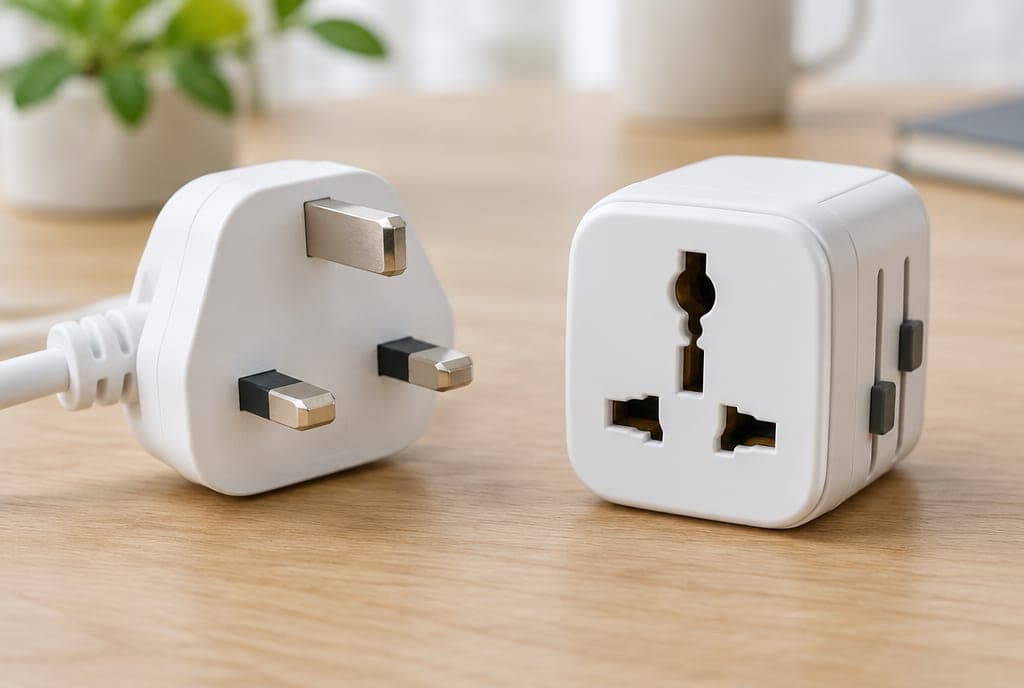
Dubai, and the United Arab Emirates as a whole, runs on the same electrical standard as the UK and Ireland. The socket takes the Type G three-pin plug — three rectangular pins in a triangular layout — and the mains supply is 230 volts at 50 hertz.
If a device and its plug both come from the UK or Ireland, they work here with nothing extra. Everyone else needs to think about two separate things: the plug shape and the voltage.
| Detail | Dubai and the UAE |
|---|---|
| Plug type | Dubai and the UAEType G (three rectangular pins) |
| Voltage | Dubai and the UAE230V, within the 220-240V band |
| Frequency | Dubai and the UAE50 Hz |
| Matches | Dubai and the UAEUK and Ireland |
The 230V figure sits in the standard 220-240V range, so devices labelled for that band are fine.
Do you need a plug adapter in Dubai?
Whether you need an adapter depends only on the shape of your plug, not on the country you flew in from. The question is simple: do your plugs have the three rectangular Type G pins, or something else?
If they are anything other than Type G, you need an adapter to make them fit the socket. That is a different job from the voltage, which the next section covers.
| Where your plugs are from | What you need |
|---|---|
| UK or Ireland | What you needNothing — your plugs already fit |
| US, Canada or Japan | What you needA Type G plug adapter |
| Europe, with Type C two round pins | What you needA Type G adapter |
| Anywhere else | What you needA Type G or universal adapter |
An adapter changes the plug shape only. It does nothing to the voltage coming out of the wall.
Adapter or voltage converter — which do you need?
This is the part that catches people out. A plug adapter only lets your plug physically fit the socket. It does not change the 230-volt supply at all.
Most modern chargers cope with that supply on their own. Look at the small print on the charger or its label for the word INPUT. If it reads 100-240V, the device is dual-voltage and works anywhere, so a plug adapter is all it needs. Phone, laptop, tablet and camera chargers almost always fall into this group.
A single-voltage device is the exception. If the label says only 110-120V — as some US hairdryers, straighteners and other heating appliances do — then 230 volts is roughly double what it expects. Plugging it in through an adapter alone can damage it. For those you need a voltage converter, which actually steps the voltage down, not just a plug adapter.
Type C sockets and USB points you might find
Most of the rooms you are likely to stay in have standard Type G sockets. There are two common variations worth knowing about before you travel.
- Some older or budget buildings have Type C sockets, which take two round pins. A universal adapter covers both Type G and Type C, so either way you are sorted.
- Newer hotels increasingly build USB sockets into the wall or the bedside units. Where those exist, you can charge a phone or tablet straight from the USB port with no adapter at all.
What to pack for your devices
You can keep this simple. A little preparation before you fly means you are not hunting for a shop on your first evening.
- A Type G adapter, or a universal adapter that includes Type G — one for each device you want to charge at the same time.
- A quick read of the INPUT label on each charger before you pack, so you know what is dual-voltage and what is not.
- Leave a 110-120V-only hairdryer or straightener at home. Hotels usually provide a hairdryer, so you may not need your own at all.
A single universal adapter plus a quick read of each device's INPUT label covers almost every traveller. The one thing it will not fix is a single-voltage heating appliance — for that, leave it at home rather than risk it on the 230-volt supply.
Frequently asked questions
Do UK and Irish plugs work in Dubai?
Yes. Dubai and the wider UAE use the Type G three-pin plug, the same design as the UK and Ireland, so your plugs fit the sockets directly. The supply is also 230 volts, the same band as at home, so UK and Irish appliances run normally without an adapter or a converter.
Will my US hairdryer work in Dubai?
Only if it is dual-voltage. Many US hairdryers and straighteners are built for 110-120V alone, and Dubai's 230-volt supply can damage them even through a plug adapter. Check the label: if it reads 100-240V you are fine with an adapter, but if it says only 110-120V, leave it at home — hotels usually provide a hairdryer.
Do phone and laptop chargers need a voltage converter?
Almost never. Most phone, laptop, tablet and camera chargers are dual-voltage, meaning their INPUT label reads 100-240V, so they only need a Type G plug adapter in Dubai. It is still worth checking the input label on each charger, as a single-voltage device would be the exception.
What is a Type G plug?
A Type G plug has three rectangular pins set in a triangular layout, with a fuse inside the plug. It is the standard plug in the UK and Ireland, and Dubai and the rest of the UAE use the same one, at 230 volts and 50 Hz.
What happens if I plug a 110-volt device in with only an adapter?
A plug adapter changes only the shape of the pins, not the voltage. If a device is built for 110-120V alone and you connect it to Dubai's 230-volt supply through an adapter, it receives roughly double the voltage it expects and can be damaged. Devices marked 100-240V are dual-voltage and are not affected.
Written by the TripReview team from our own price benchmarks and the rules published by UAE authorities, and updated 22 October 2026. Figures are ranges, not quotes — check the latest rules with the official source before you travel. How we rate companies