Quick answer
Yes. Al Ain is about 130 km from Dubai, usually 1 hour 15 minutes to 1 hour 40 minutes by road on the E66, so it works as a full day out. It feels very different from the coast: a UNESCO-listed date-palm oasis, mud-brick forts, a museum that reopened in 2025, a large zoo and the Jebel Hafeet mountain road with views over the city. The catch is time, because the zoo alone takes three to four hours, so you choose between a heritage-and-mountain day and a zoo day. Summer afternoons are also hotter than in Dubai, so the cooler months, roughly October to April, are the comfortable time to go.
What makes Al Ain different from Dubai and the coast?
Al Ain is the UAE's inland oasis city, in the emirate of Abu Dhabi and right on the Omani border at Buraimi. It is known as the Garden City for its date-palm oases, parks and tree-lined avenues. There is no coastline and the skyline is low, so the draw is shade, old farmland and a mountain rather than sea views and skyscrapers. In 2011 it became the UAE's first UNESCO World Heritage Site, as the Cultural Sites of Al Ain.
The listing spans 17 locations in four groups, from stone tombs about 5,000 years old on Jebel Hafeet and a farming settlement at Hili dated to around 2500 BC to the oases and the falaj channels that carry water to their palms. Not every site is open to visitors, but the oasis, the museum and the tombs at the foot of the mountain put much of the story within reach of a day trip.
How far is Al Ain from Dubai, and how do you get there?
The direct route is the E66, the Dubai–Al Ain Road, which stays inside the UAE the whole way. Expect about 130 km from central Dubai and, as a rule, 1 hour 15 minutes to 1 hour 40 minutes behind the wheel; the zoo's own directions quote about 90 minutes. Western districts such as the Marina sit further from the Al Ain road, and peak-hour traffic can slow it, so leave a margin for the way home. Oman only comes into the trip if you deliberately cross at Hili or Mezyad, which is something to check with your rental company first.
Having your own car suits Al Ain's layout, since the oasis, forts and museum cluster in the centre but the mountain is about 11 km south of it and the zoo sits at its foot. The alternatives are intercity buses, which leave Dubai's Al Ghubaiba and Al Aweer stations and take about two hours according to the zoo's directions, and organised day tours. With either, you rely on taxis between the sights or on a tour's stops and pace.
Check whether your route out of Dubai crosses a Salik gate; the charge goes through the car's tag, so ask your rental company how it is passed on. In Al Ain, paid roadside parking applies in some central streets, so read the bay signs; the zoo advertises free parking by its main entrance.
What is there to see in Al Ain?
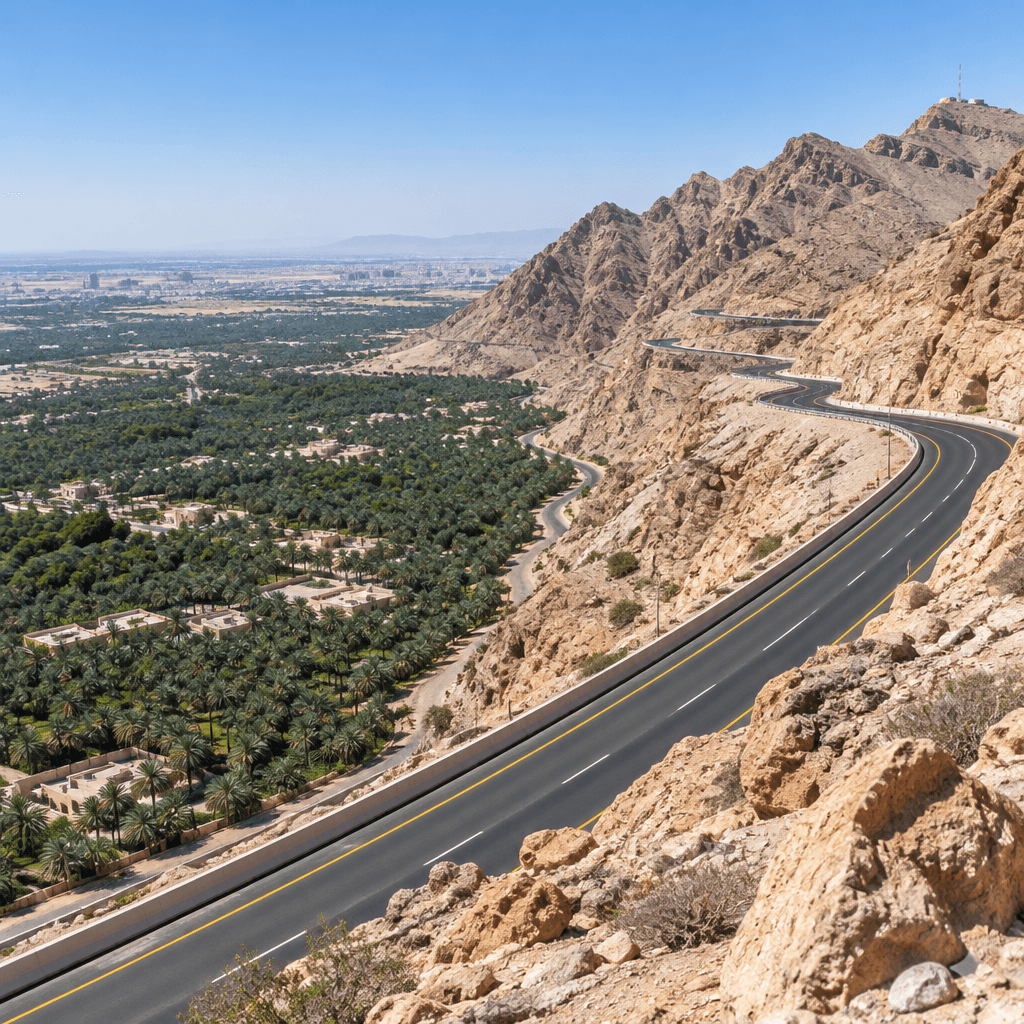
Jebel Hafeet, the mountain south of the city, is the reason many people make the trip. The road up is about 11 km of well-paved tarmac with a long run of bends, ending at a car park and viewing area near the top. Official tourism pages give the height as about 1,250 m and call it the highest peak in the emirate of Abu Dhabi, and the top is usually cooler than the city below. Sunrise and sunset are the popular times, and a low gear on the way down spares the brakes. At the foot, the desert park has hiking trails and the beehive tombs, about 5,000 years old and part of the UNESCO listing.
Al Ain Oasis, part of the UNESCO listing, covers about 1,200 hectares in the middle of the city, with roughly 147,000 date palms along shaded paths. The falaj channels that carry water to the palms are what the visit is about: the Eco-Centre, free to enter, explains how they work, and you can walk or hire a bicycle or electric buggy at the entrance. Water flow varies by season, so a channel may be dry when you visit. The oasis was free to enter at the time of writing.
Al Jahili Fort is a mud-brick fort that Sheikh Zayed bin Khalifa Al Nahyan, known as Zayed the First, began in 1891 and completed in 1898. Entry is currently free, and a permanent exhibition inside covers the explorer and photographer Wilfred Thesiger. Close by, Al Ain Museum, also known as the Al Ain National Museum, was founded in 1969 as the UAE's first museum and reopened in October 2025 after a major redevelopment. It is ticketed and stands beside the early 20th-century Sultan Fort, with Iron Age irrigation channels preserved where they were found.
Qasr Al Muwaiji, a mud-brick fort on the western edge of the city, was the home of Sheikh Zayed bin Sultan Al Nahyan, the UAE's founding father, and is where his son Sheikh Khalifa was born in 1948; entry was free when we checked. The Al Ain Palace Museum, Sheikh Zayed's former residence, closed for renovation in July 2024, so check whether it has reopened before planning around it.
Al Ain Zoo, which Sheikh Zayed bin Sultan Al Nahyan founded in the late 1960s, lies at the foot of Jebel Hafeet and suits families. Its own guidance is to allow three to four hours and to visit between October and April. Entry is ticketed, the safari is a separately priced extra, and opening hours change with the season.
Two smaller stops need a little care. Green Mubazzarah, a park at the foot of the mountain, has lawns, a lake and naturally warm springs; entry was free at the time of writing, with swimming and other activities charged separately. The camel market is a working livestock market, busiest in the morning, and official tourism pages advise planning a visit in advance, one saying visits must be supervised by market staff.
Is Al Ain a comfortable day trip, or better as an overnight?
One day covers the central sights and the mountain, or the zoo and one other stop; trying for all three leaves no margin. The round trip is about three hours of driving. Official visitor pages suggest roughly two hours for the oasis, an hour for Al Jahili Fort and about three for Jebel Hafeet, while the zoo asks for three to four hours on its own.
For the heritage-and-mountain version, leave Dubai by about 7.30am, reach the centre as the sights open around 9am, and spend the morning in the oasis, then the fort and the museum, which are close together. Have lunch in town, drive south to Jebel Hafeet for the last hour or two of daylight, then head home. From November to January the sun sets at about half past five, so the drive back is mostly in the dark.
With children, or if the animals are the point, swap the heritage morning for the zoo and pair it with the mountain or Green Mubazzarah, which are on the same side of the city. To add the old centre to the zoo, or to catch both sunrise and sunset on the mountain, stay a night: the city has hotels and Green Mubazzarah has chalets.
Do the shaded sights first and save the mountain for the end of the day, when the light is softer and the top is cooler.
When should you go to Al Ain, and what should you bring?
Aim for October to April, the window the zoo itself recommends and the one that suits the oasis and forts too. From about May to September Al Ain is a few degrees hotter than Dubai by day, with July afternoons averaging around 44°C, although the air is drier than on the coast. In summer, do the oasis and forts at opening time, keep an indoor stop or the cooler mountain top for the afternoon, and check the zoo's dates.
Carry water, a hat and shoes you can walk in, plus a light jacket for the mountain top after dark. Dress modestly, with covered shoulders and knees as a safe rule: the official tourism page asks camel market visitors to dress modestly and respectfully, and the same courtesy suits the forts and older neighbourhoods.
Friday hours can differ, with some sites opening later in the day around the midday prayer. Ramadan brings its own opening hours, set each year, and several heritage sites close on the first day of Eid al Fitr and Eid al Adha. Roads around Jebel Hafeet are occasionally closed for events such as cycling races, so check Abu Dhabi's traffic notices before you set out.
Hours and prices for the same site often differ between official pages and travel listings, so confirm each stop with the venue the day before.
Frequently asked questions
How far is Al Ain from Dubai?
By road it is about 130 km from central Dubai to Al Ain, usually 1 hour 15 minutes to 1 hour 40 minutes on the E66, and longer at peak times or from western districts such as the Marina. The zoo's own directions put the drive at about 90 minutes.
Can you visit Al Ain in a day from Dubai?
Yes, though not all of it at once. The drive takes about three hours in total, which still leaves time for the oasis, Al Jahili Fort and a late visit to Jebel Hafeet, or for the zoo, which needs three to four hours on its own. Stay a night if you want the heritage sights, the zoo and the mountain together.
Do you need a car to get to Al Ain?
You can reach Al Ain without one: intercity buses leave from Dubai's Al Ghubaiba and Al Aweer stations and take about two hours, and organised day tours run from Dubai. Getting between the sights is the harder part, because they are spread from the central oasis out to the mountain, so without a car you depend on taxis or a tour's route.
What is Al Ain known for?
Al Ain is known as the Garden City for its date-palm oases, and it holds the UAE's first UNESCO World Heritage listing, the Cultural Sites of Al Ain, inscribed in 2011. Visitors go for the oasis and its falaj channels, the mud-brick forts and the museum, the zoo, and Jebel Hafeet, the mountain with a winding road to the top.
Is a day trip to Al Ain worth it?
It is worth it if you want shade, history and a mountain drive rather than beaches and skyscrapers, and if you go in the cooler months. It is less rewarding on a midsummer afternoon, when the heat limits what you can do outdoors, or if you only have a few hours, because the round trip alone takes about three. Choosing one theme keeps the day relaxed.
Written by the TripReview team from our own price benchmarks and the rules published by UAE authorities, and updated 23 October 2026. Figures are ranges, not quotes — check the latest rules with the official source before you travel. How we rate companies